Mrs De Runtzen's Jewels.
A Ghost Story.
One freezing, foggy night in early February, Inspector Arthur C. Behrends of the Metropolitan Police walked along a cramped, shabby alleyway off the Whitechapel Road, a scruffy, barefoot little boy running on ahead of him as his guide. The Inspector was in pursuit of the solution to a mystery, a scandalous crime that had shocked the finer elements of London society. He believed that solution lay here, in the slum-dwellings of the poor.
Sometimes he would lose sight of the unkempt boy as he disappeared in the clammy grasp of the thick, grey fog, but then moments later he would appear again, urging the Inspector on with quick, insistent whispers.
“This way, mister! Down ’ere, quickly, quickly!”
Occasionally Behrends would be compelled to stop as a sudden dark shape appeared through the eddies and swirls of the smog, a ghostly shadow emerging from the mist to become a filthy, bent beggar, wheezing his pitiful entreaties into Behrends’ ear, or a haggard old woman, offering to sell the policeman a pair of pig’s trotters.
Behrends dismissed them all, waving them away contemptuously, for he was a dour, tubby little man, and his social graces were sorely lacking in every respect. It was said by his colleagues that his temper was even shorter than he was, but that when provoked into a fit of passionate rage he could grow twice his normal size.
“Down ’ere, mister,” the street urchin said, suddenly appearing wraith like through the fog and pointing down a side street.
Behrends followed the boy down the cramped street. The black, filthy buildings towered over him on either side, threatening to close in on him and squeeze the breath from his freezing lungs. Somewhere in the distance he could hear a group of men singing a bawdy song set to the tune of a Salvation Army hymn, and a woman shrieking, with delight or fear he could not tell. He passed broken windows, patched up with rags and paper, and his feet sloshed through a foul river of sludge, the underground cesspits having overflowed in the recent storms. They reached a warped, broken down door, which the boy pushed open, and entered a dismal little room, lit only by the fire burning in the grate.
A woman sat at a table assembling matchboxes, dropping them in an untidy pile on the floor beside her. Her face and bare arms were as white as ivory in the flickering light of the fire, apart from the scattering of blue and yellow bruises that marked her flesh. Two filthy children sat silently on the floor, their faces blank with hunger.
Ignoring the woman and children, Inspector Behrends and his guide passed through the room and ascended a flight of perilously rickety steps to the first floor. Behrends stepped carefully, unable to see much in the poor light. As he climbed, he ran his hand along the damp, mildewed wall to steady himself.
“In ’ere mister,” the boy said, pushing open a door into a shabby little bedroom lit by a single, sputtering gas lamp.
Two rickety cast iron beds dominated the tiny room. On one of these decrepit beds lay a white-haired man, covered from his neck to his toes by a stained, threadbare sheet, tucked up under his chin. He was shivering violently.
Beside him, on the edge of the other bed, sat a thin, haggard looking woman, her trembling hands clasped together as though in prayer.
A mean little fire burned pitifully in a black grate, providing precious little comfort against the cold and damp.
“Is it the peelers?” the man said, his hoarse, cracked voice penetrating the silence like a knife.
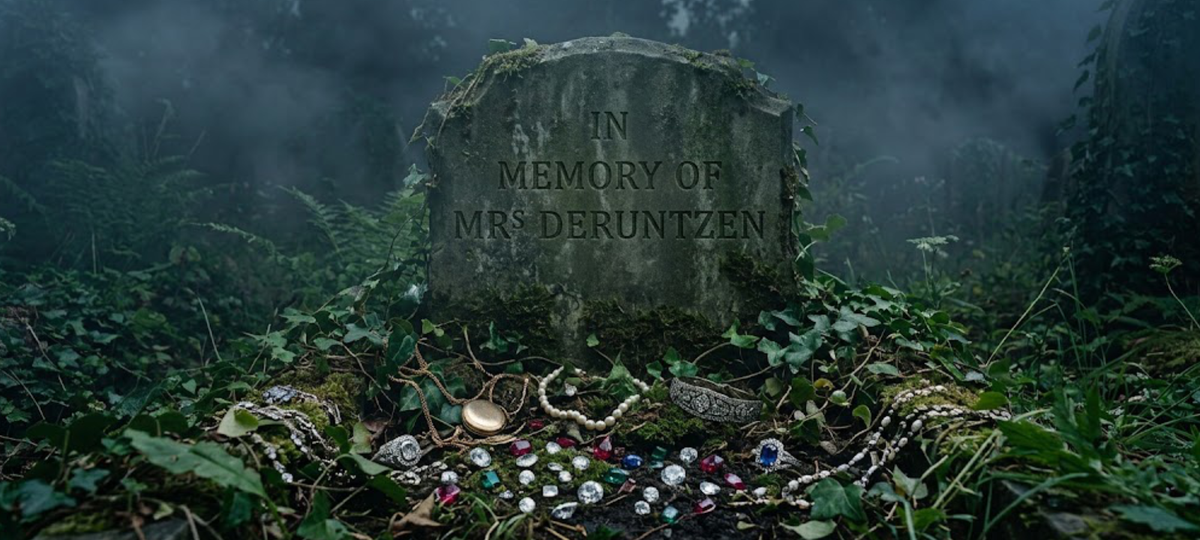
“My name is Inspector Behrends, I believe you have some information about the desecration of Mrs De Runtzen’s grave,” Behrends said, still standing in the doorway.
“Yeah, that’s right, that’s right,” came back the hoarse reply. “Molly, let the Inspector sit down, there’s a good lass.”
The thin, haggard woman shuffled between the beds and found herself another spot, and Behrends sat down next to the man, who looked up at him from his sickbed with bruised, haunted eyes. Behrends caught the whiff of cheap booze on his breath and stale sweat on his body. Behind the hollow walls, he could hear the constant scurrying to and fro of rats.
“My name’s Bill Sketch,” the man said, his dry, cracked lips parting to reveal a few rotten, dark brown teeth, and a black tongue.
Behrends looked at Sketch, at his gaunt face, and his shock of white hair.
“It were as black as coal yesterday,” Sketch said. “Ain’t that right, Molly? As black as midnight, it were.”
“And what happened,” Behrends said, “to turn your hair so white in a day?”
“D’yer believe in ghosts, Inspector?” Sketch whispered.